> For the complete documentation index, see [llms.txt](https://docs.crystal.exchange/llms.txt). Markdown versions of documentation pages are available by appending `.md` to page URLs; this page is available as [Markdown](https://docs.crystal.exchange/spot-trading/amm-vs-clob.md).
# AMM vs CLOB
Crystal is the most versatile and efficient decentralized CLOB.
## What is an AMM ? (Automated Market Maker)
Historically, most decentralized exchanges have relied on an automated market maker (AMM) architecture due to its simplicity and low performance requirements. This is because the pricing logic of AMMs exists entirely onchain via mathematical equations, meaning liquidity providers do not have to submit transactions to update quotes. Additionally, the simple and straightforward "deposit and earn" model has attracted many retail investors due to its simplicity and low barrier of entry to liquidity provision.
The most widely used AMM formula is `x * y = k` which establishes a price range for two tokens based on their balances in the liquidity pool, also known as the constant product AMM. When the token supply of Token X increases, the supply of Token Y decreases proportionally to maintain the constant product K. [Uniswap](https://uniswap.org) V2 is a notable example of a constant product AMM, and it continues to retain a high market share in part due to the effectiveness of this simple algorithm. AMMs are especially optimal for long tail assets that market makers would be unlikely to quote as the algorithm guarantees assets are tradeable no matter the market conditions.
Visualization of a constant product AMM curve
### Impermanent Loss
However, AMMs have many drawbacks. When the price of an asset changes on a different exchange, the price on the AMM remains the same, and arbitrage bots can profit from the stale quotes at the expense of liquidity providers. Additionally, when the price of a market drifts away from the initial price, liquidity providers experience a phenomenon known as impermanent loss, in which they would underperform simply holding both assets in a 50/50 proportion. Finally, AMMs must charge high fees to compensate for these two factors, and their mathematical curve-based quoting logic means traders will experience significant price impact on large trades as well. The majority of AMM liquidity loses money and/or is subsidized via token incentives.
### Low Capital Efficiency
Compared to orderbook exchanges, traditional AMMs require much larger amounts of capital to achieve the same liquidity. This is because a significant amount of AMM liquidity sits stale at both ends of the curve, only becoming of use when the price moves to an extreme. Because of this, at any given moment only a fraction of liquidity is actually active within reasonable levels of price impact to be traded against. On the other hand, on orderbook exchanges market makers actively manage their positions by setting specific buy/sell prices close to the mid price, leading to much more effective capital usage.
Learn more about AMMs: \[[Coinbase](https://www.coinbase.com/learn/advanced-trading/what-is-an-automated-market-maker-amm)] \[[Chainlink](https://chain.link/education-hub/what-is-an-automated-market-maker-amm)]
***
## What is a CLOB? (Central Limit Order Book)
A central limit order book (CLOB) is a form of market architecture where buy and sell orders are matched according to price-time priority. Orderbooks are the dominant market architecture in traditional financial markets due to their versatility and efficiency. Contrary to AMMs, orderbooks allow market makers a lot more flexibility in how they want to quote as they can place orders at individual price points. They are also much more capital efficient as useres only place orders at prices they want to trade at.
Learn more about CLOBs: \[[Wikipedia](https://en.wikipedia.org/wiki/Central_limit_order_book)] \[[Nasdaq](https://www.nasdaq.com/articles/demystifying-the-central-limit-order-book-clob-everything-you-need-to-know)]
### How Do CLOBs Work?
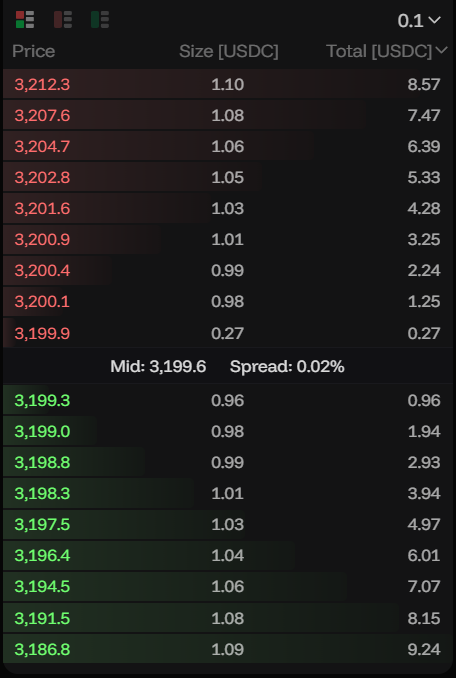
If a trader wants to buy 1 Ethereum when it reaches $3200, they place a limit order to the order book. If a seller is willing to sell 1 Ethereum at $3200, the two orders will get matched, and the trade will be executed. If no seller is found or available at that price, the order will remain in the book until a matching seller is found.
Crystal's Orderbook
Crystal utilizes an orderbook architecture due to the benefits stated above. On Crystal, the order book is updated live so that one can visualize market depth and liquidity in real time. With superior capital efficiency and more competitive quotes, Crystal is the first step to bringing onchain markets to parity with traditional financial markets in terms of speed and performance.